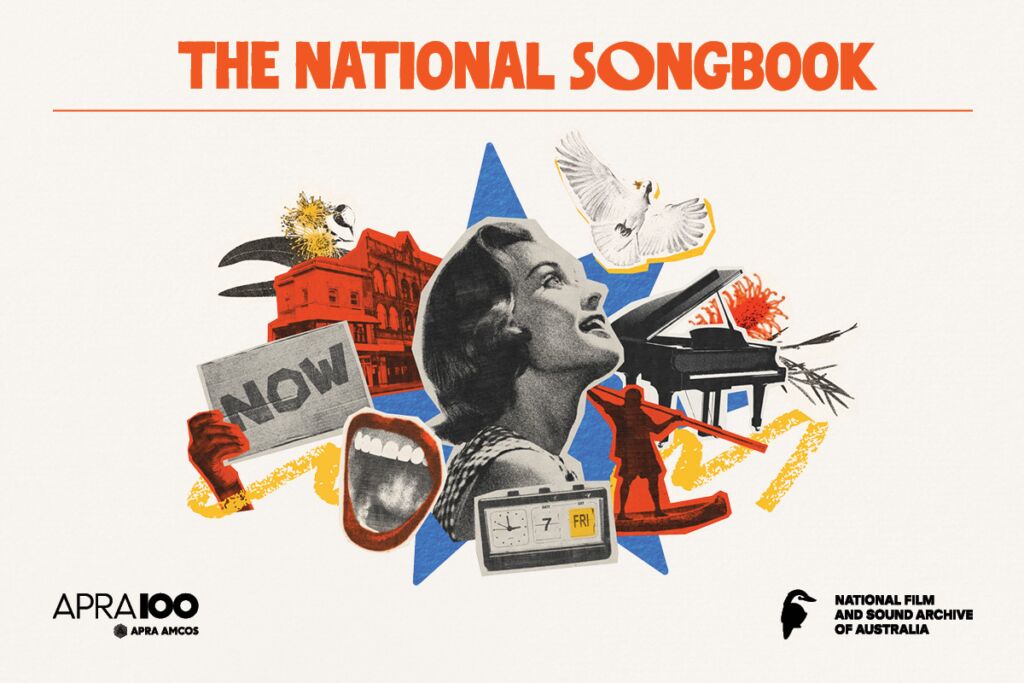
APRA AMCOS and the National Film and Sound Archive of Australia (NFSA) have announced the first 10 songs to be inducted into The National Songbook, a new annual initiative celebrating and preserving the songs that have helped shape Australia’s cultural identity.
Celebrated at a special event at the NFSA in Canberra on November 4, The National Songbook honours the songs, songwriters and composers whose creative vision has given voice to Australian stories.
The inaugural 10 songs span more than a century of Australian songwriting heritage, from traditional bush ballad ‘Waltzing Matilda’, written by Andrew ‘Banjo’ Paterson and Christina Macpherson and first recorded in 1927, through to The Presets’ iconic 2007 dance anthem ‘My People.’
A wide range of genres and musical styles have been chosen for their artistic and cultural significance, including the 1966 global hit ‘Friday on My Mind’ by George Young and Harry Vanda; Helen Reddy and Ray Burton’s feminist anthem of 1971 ‘I Am Woman’; plus protest songs ‘Beds Are Burning’ by Midnight Oil’s Jim Moginie, Peter Garrett and Rob Hirst (1987) and 1991’s landmark ‘Treaty’ written by Dr M. Yunupingu, Stuart Kellaway, Witiyana Marika, M. Mununggurr, Cal Williams, G. Yunupingu, Peter Garrett and Paul Kelly.
Personal experience as a powerful act of storytelling is celebrated by the induction of Ruby Hunter’s 1990 classic ‘Down City Streets,’ while the enduring connection between people and place is highlighted in Neil Murray’s ‘My Island Home’ (1987), a hit with both Warumpi Band and later with Christine Anu.
Screen and classical compositions round off the final 10, with Peter Sculthorpe’s evocative sound world ‘Earth Cry’ (1990) and the 1998 score to Australian cult thriller The Boys,written by The Necks’ Chris Abrahams, Tony Buck and Lloyd Swanton.
The inaugural event features thoughtful interpretations of the inducted songs including ‘I Am Woman’ performed by Deline Briscoe, The Boys soundtrack by Barney McCall, and ‘Down City Streets’ by Emma Donovan.
The National Songbook recognises individual Australian songs and compositions that have demonstrated lasting significance and contributed to the nation’s shared cultural heritage. It will become a permanent digital archive, preserving these works for future generations and ensuring Australians can continue to discover the songs that have helped define the nation.
Dean Ormston, CEO of APRA AMCOS, explains: ‘No 10 songs could ever tell the whole story of Australia, but together these inaugural inductees help us understand, as a nation, where we’ve come from, who we are and the values we’ve carried through generations.
‘As APRA celebrates 100 years of championing songwriters, composers and music publishers, we welcome these debut entries into The National Songbook as songs that have helped become part of our shared cultural story, reflecting the extraordinary breadth, diversity and richness of Australian songwriting and composing.’
Meagan Loader, Chief Curator of the NFSA, adds: ‘The National Songbook reflects the remarkable breadth of Australian songwriting and composition, from songs of protest, belonging and identity to works that have become woven into our national story and our DNA. As Australia’s audiovisual archive, the NFSA will ensure these songs and stories are preserved in our national collection of works of significant cultural heritage, heft and heart, providing a new way for Australians now and into the future to engage with the songs and songwriters who have shaped us.’
To be eligible for inclusion in The National Songbook, songs must be written or co-written by an Australian APRA member, must have been released at least 10 years prior to consideration, and must demonstrate significant cultural impact within Australia.
This year’s inaugural inductees were chosen by a panel of 10 industry experts from across the musical spectrum including songwriters, composers, broadcasters, journalists and historians, chaired by APRA Chair Jenny Morris MNZM OAM and NFSA Chair Annette Shun Wah.
For more information and to view the full collection, visit nfsa.gov.au
Listen to The National Songbook playlists on Apple Music, Spotify and YouTube Music.
Beds Are Burning
Written by Peter Garrett / Rob Hirst / Jim Moginie.
Released: 1987
The explosive trumpet-and-drum bursts of Midnight Oil’s ‘Beds Are Burning’ brought a call for Aboriginal land rights to the airwaves in the lead-up to Australia’s 1988 bicentenary. The song took shape after the band toured Central Australia, where Peter Garrett, Rob Hirst and Jim Moginie encountered First Nations communities and learned more about their experiences of displacement and inequality. ‘We were in a timeless land occupied by people for millennia,’ recalls Garrett, ‘with hardly any idea of what had come before us.’ The landscape left its mark on the lyrics, from Holden wrecks and ancient bloodwood trees to the names Kintore and Yuendumu. Driven by an urgently ticking rhythm, this distinctly Australian protest song became Midnight Oil’s biggest international hit.
Down City Streets
Written by Ruby Hunter.
Released: 1990
Ruby Hunter’s ‘Down City Streets’ opens with the stark image of crawling out of the bushes at dawn. With no bed or possessions, survival becomes a matter of improvisation – fingers for a comb, newspapers for warmth.
A member of the Stolen Generations, Hunter wrote ‘Down City Streets’ as a way to process her personal experience of displacement. But it was her husband, Archie Roach, who initially recorded the song for his watershed album, Charcoal Lane (1990). Years later, Hunter recorded her own version, finally ready to share her powerful story in her own voice. Sparse acoustic accompaniment brings the tentative, often painful nature of remembrance to the fore, and the song’s themes are still resonant for young First Nations people today.
Earth Cry
Composed by Peter Sculthorpe.
Released: 1990
Can an orchestra capture the vastness of Australia? Commissioned by the ABC in 1986, Peter Sculthorpe’s ‘Earth Cry’ explores this question by expanding the boundaries of classical music. As an Australian composer, Sculthorpe was tired of rehashing Eurocentric conventions that failed to fully capture his homeland’s ancient and intertwined creative legacies. He drew on both European and First Nations traditions to craft a distinctly Australian sound, his sweeping orchestration allowing different instrumental voices to share the same melody. First and second violins answer one another, while lower strings and brass build a sense of gathering force. Traditional European harmonies rumble like an approaching storm beneath William Barton’s didgeridoo playing, bringing contrasting musical traditions into dialogue. Through these shifting textures and competing voices, ‘Earth Cry’ offers Sculthorpe’s vision of a vast, complex Australian landscape.
Friday on My Mind
Written by Harry Vanda and George Young.
Released: 1966
Five days of drudgery, two days of freedom. Harry Vanda and George Young’s ‘Friday on My Mind’ turns the working week into a countdown, its impatient, toe-tapping beat building towards the promise of Friday night. Recorded by the Easybeats in 1966, amid Beatlemania, transistor radios and rapidly changing musical tastes, the song captured the restless energy of a generation hungry for romance and escape. Having first come together at the Villawood Migrant Hostel, Vanda and Young reflected an Australia increasingly shaped by migration and new cultural influences. Their garage-rock anthem – widely considered the first Australian rock song to become a global hit – found something universal in the ‘five-day grind’ and the blissful prospect of leaving it all behind for the weekend.
I Am Woman
Written by Helen Reddy and Ray Burton.
Released: 1971
When Helen Reddy turned on the radio in the early 1970s, she struggled to find songs that reflected her experiences and those of the women around her. Germaine Greer’s The Female Eunuch was a worldwide bestseller, and campaigns for equal pay were gathering momentum. Reddy wanted to hear that changing world in music. With Ray Burton, she wrote ‘I Am Woman’, a defiant call-to-arms for women around the world that balances defiance with hope. Its narrator is roaring, wise and invincible, yet still ‘an embryo / with a long, long way to go’. The song became an anthem of the women’s liberation movement, giving Reddy’s personal ambitions a voice that resonated far beyond her own time – and experience.
My Island Home
Written by Neil Murray.
Released: 1987 (Warumpi Band) 1995 (Christine Anu)
Neil Murray was travelling away from Galiwin’ku, the island home of his bandmate George Burarrwanga, when the idea for ‘My Island Home’ came to him. Thinking of his friend and his own home in western Victoria, he began writing about the pull of Country – physically distant but always present. For Burarrwanga, the song spoke to his experiences as a Yolŋu man moving between sea and desert. Christine Anu’s celebrated 1995 cover brought another perspective, shaped by her Torres Strait Islander heritage and life in Cairns and inner-city Sydney. When Anu performed the song at the 2000 Sydney Olympics, it reached an enormous audience, expressing something deeply personal yet widely understood: the enduring pull of home and belonging.
My People
Written by Julian Hamilton / Kim Moyes.
Released: 2007
Julian Hamilton and Kim Moyes were holed up in Bangalore, searching for a missing ingredient: a throbbing, ‘obnoxious sound’ that would get crowds jumping. The result was the snarling, synthesiser-powered energy of ‘My People’ – a dancefloor anthem with a political charge. During overseas tours, the electro-pop duo were repeatedly asked about Australia’s treatment of asylum seekers. Against the track’s dark, industrial pulse, Hamilton delivers a defiant declaration of solidarity: ‘I’m here with all of my people / locked up with all of my people!’ Years of radio play, advertising and sports broadcasts have made ‘My People’ a familiar Australian soundtrack. Its political message may be less immediately apparent to listeners today, but its ferocity remains – a product of an indie scene where music and activism frequently overlapped.
The Boys – The Necks (Soundtrack)
Written by Chris Abrahams / Tony Buck / Lloyd Swanton.
Released: 1998
The Necks’ unsettling score for The Boys (1998) gradually exposes the darkness simmering beneath suburban life. Based on a real-life murder, the film sidesteps familiar crime-thriller conventions to explore a man’s troubled psyche. Avant-garde trio The Necks, known for the lengthy live improvisations, take similarly unsettling turns, resisting the dramatic cues of a conventional film score. Instead, sparse instrumentation and off-kilter rhythms sustain a creeping sense of unease. The close relationship between sound and screen began early, with the musicians involved in story development, location visits and rehearsals. The result is an immersive portrait of Sydney’s underbelly, where drifting notes and uneasy silences steadily erode any sense of calm – until fuzzed-out guitars signal the violence to come.
Treaty
Written by Dr M. Yunupingu / Stuart Kellaway / Witiyana Marika / M. Mununggurr / Cal Williams / G. Yunupingu / Peter Garrett / Paul Kelly
Released: 1991
In 1988 at Barunga, Prime Minister Bob Hawke publicly promised a treaty with First Nations Australians. Three years later, with that promise still unfulfilled, Yothu Yindi frontman Dr M. Yunupingu reignited the conversation through song.
Co-written around a campfire with Paul Kelly and Peter Garrett, ‘Treaty’ blended an urgent call for action with joyful Djatpangarri rhythms, electric guitar riffs, and the rallying refrain: ‘Treaty yeah / Treaty now!’
The track exploded onto dancefloors worldwide with Filthy Lucre’s iconic 1991 remix. By pairing electronic beats with the yidaki (didgeridoo), bilma (clapsticks), and Yolŋu Matha lyrics, it brought the political movement to a massive new audience. Decades later, contemporary acts like East Journey continue to perform the anthem—honouring the Yolŋu tradition of passing songs down through generations to keep its message alive.
Today, ‘Treaty’ remains a landmark protest anthem of immense significance to First Nations peoples. It is the heartbeat of the land rights movement. Frequently played at marches, its driving rhythm flows through you like blood through your body, like rivers through the land—powerfully propelling the listener forward.
Waltzing Matilda
Written by Andrew ‘Banjo’ Paterson – lyrics, Christina Macpherson – melody
Released: 1927
At heart, it’s a ghost story. A swagman evades his pursuers, leaving behind a refrain that echoes from beyond the grave: ‘You’ll come a-Waltzing Matilda, with me.’ Andrew ‘Banjo’ Paterson’s elusive wanderer looms large in Australian folklore, alongside bushrangers such as Ned Kelly. The song’s history is similarly slippery, passing through successive reinventions. Christina Macpherson’s melody drew on her memory of Thomas Bulch’s ‘Craigielee’ – itself adapted from a setting of a Scottish poem. In 1903, Marie Cowan fashioned the version most familiar today, while John Collinson and Russell Callow later made its first commercial recording. A patchwork of borrowed melodies and bush mythology, ‘Waltzing Matilda’ remains one of Australia’s most enduring hauntings.